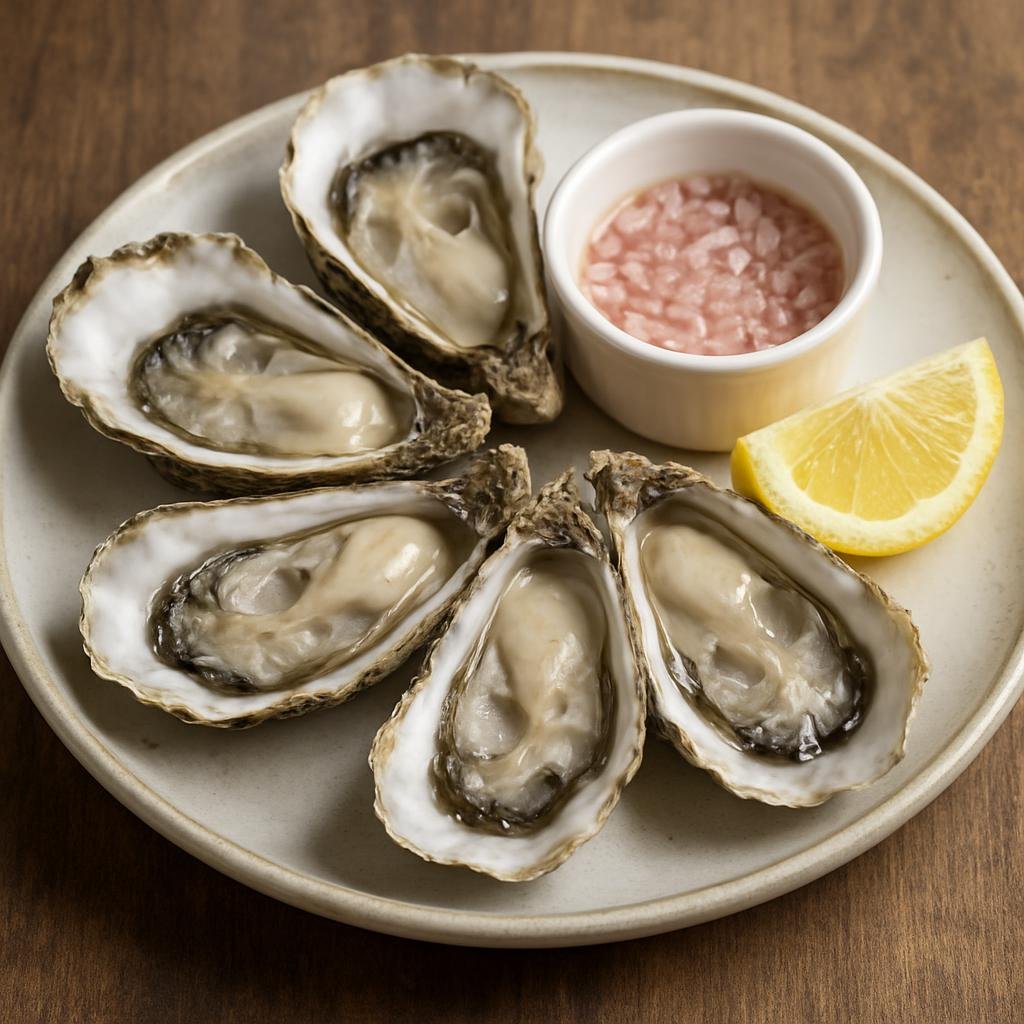
Entree: Netherlands – North Sea Coast – Zeeuwse Oesters (Fresh Zeeland oysters served raw with a classic shallot-mignonette and lemon)
Food safety reminder: Follow safe food-handling practices and use a food thermometer to verify safe internal cooking temperatures.
Serving Size: 4
Approximate Time
Prep
20 min
Cook
0 min
Additional
15 min
Total
35 min
Ingredients
U.S. measurements first, metric equivalents in parentheses. Conversions are approximate; oz means weight ounces, not fluid ounces.
- 24 Zeeuwse Oesters, approx. 2.5 oz (70 g) each
- 3 tbsp (45 ml) red wine vinegar
- 1 small shallot, finely minced (about 0.53 oz (15 g))
- 1/2 tsp (1 g) freshly cracked black pepper
- 1/2 tsp (3 g) fine sea salt, plus extra for serving
- 1 lemon, cut into wedges
- 8 slices rye or dark bread, toasted (about 8 oz (225 g)) (such as rye bread)
- 4 tbsp (60 g) unsalted butter, softened
- Crushed ice for serving
Show original ingredient measurements
- 24 Zeeuwse Oesters, approx. 2.5 oz (70 g) each
- 3 tbsp (45 ml) red wine vinegar
- 1 small shallot, finely minced (about 15 g)
- 1/2 tsp (1 g) freshly cracked black pepper
- 1/2 tsp (3 g) fine sea salt, plus extra for serving
- 1 lemon, cut into wedges
- 8 slices rye or dark bread, toasted (about 8 oz / 225 g) (such as rye bread)
- 4 tbsp (60 g) unsalted butter, softened
- Crushed ice for serving
Instructions
1. Chill the oysters and prepare a bed of crushed ice on a wide platter or individual plates.
2. Make the mignonette: combine red wine vinegar, minced shallot, cracked black pepper, and sea salt in a small bowl; stir and refrigerate for at least 15 minutes to meld flavors.
3. Shuck the oysters: hold each oyster cup-side down on a towel, insert a shucking knife at the hinge, twist to open, slide the knife under the muscle to free the top shell and then cut the bottom muscle to release the oyster into its cup; keep oyster liquor in the shell.
4. Arrange shucked oysters on the crushed ice, spoon a small amount of mignonette over each oyster (or serve mignonette on the side), add lemon wedges and a small pinch of extra sea salt to taste.
5. Serve immediately with toasted rye and softened butter; instruct diners to squeeze lemon and enjoy oysters raw with mignonette.
Estimated Nutritional Information*
Per serving | Servings: 4
Calories: 263 kcal
Carbohydrates: 29.5 g
Protein: 5.2 g
Fat: 14.1 g
Saturated fat: 7.9 g
Fiber: 3.9 g
Sugar: 2.9 g
Sodium: 633 mg
Potassium: 140 mg
Calcium: 52 mg
Iron: 1.81 mg
Vitamin A: 103 µg RAE
Vitamin C: 9.2 mg
Nutrition estimated: November 6, 2026
*Values are estimates based on USDA data and mathematical calculations. Actual values may vary. Where data are unavailable, those contributions are excluded. Calories, Carbohydrates, Protein, Fat, Saturated fat, Fiber, Sugar, Sodium, Potassium, Calcium, Iron, Vitamin A and Vitamin C are known subtotals. Missing contributions are unknown, not zero.