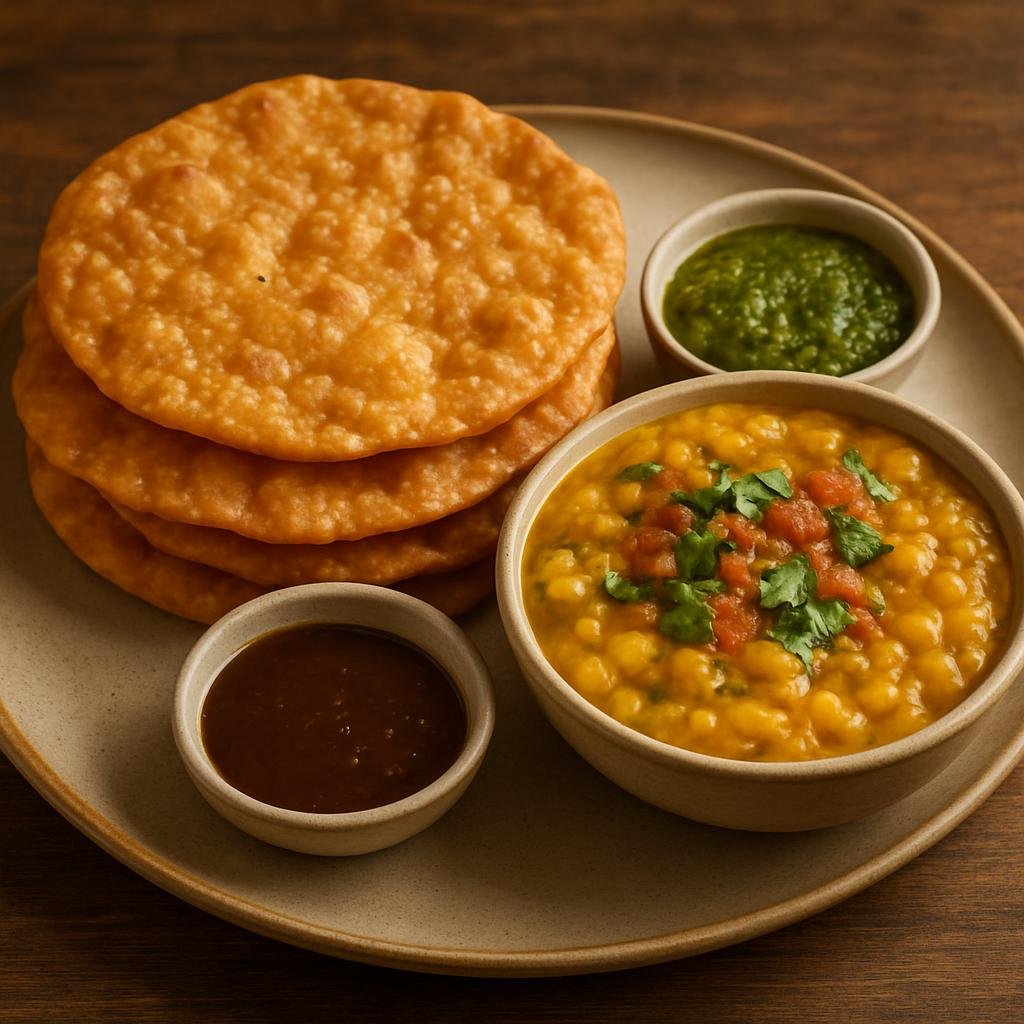
Entree: India – Sindhi-Indian – दाल पक्वान ➤ Dāl Pakwān (Crisp deep-fried flatbreads served with spiced chana dal and chutneys)
Food safety reminder: Follow safe food-handling practices and use a food thermometer to verify safe internal cooking temperatures.
Serving Size: 4
Approximate Time
Prep
45 min
Cook
35 min
Additional
30 min
Total
1 hr 35 min
Ingredients
U.S. measurements first, metric equivalents in parentheses. Conversions are approximate; oz means weight ounces, not fluid ounces.
- Pakwan dough:
  - 1 1/2 cups (180 g) all-purpose flour (maida)
  - 1/2 cup (70 g) fine semolina (sooji)
  - 1 tsp (5 g) salt
  - 1/2 tsp (2 g) ajwain (carom seeds)
  - 1/4 tsp (1 g) baking soda
  - 2 tbsp (30 ml) vegetable oil, plus more for frying
  - 1 tbsp (9 g) white sesame seeds for sprinkling
  - 3–4 tbsp (45–60 ml) water, or as needed to form a firm dough
- Chana dal:
  - 1 cup (200 g) chana dal (split chickpeas), rinsed
  - 3 cups (720 ml) water for cooking dal
  - 1/2 tsp (2 g) turmeric powder
  - 1/2 tsp (1 g) asafoetida (hing)
  - 1 tsp (5 g) salt, adjust to taste
- Tempering for dal:
  - 1 tbsp (15 ml) oil or ghee
  - 1 tsp (2 g) cumin seeds
  - 1/2 tsp (2 g) mustard seeds
  - 1 dried red chili
  - 1 tsp (2 g) minced ginger
  - 1–2 green chilies, chopped (about 0.35 oz (10 g))
  - 1 tbsp (15 ml) tamarind pulp
  - 1 tsp (4 g) jaggery or brown sugar
- Accompaniments:
  - 1 small onion, finely chopped (about 3 1/8 oz (90 g))
  - 2 tbsp (30 ml) chopped cilantro
  - Tamarind-date chutney, to taste (about 1/4 cup (60 ml))
  - Green cilantro-mint chutney, optional, to taste (about 1/4 cup (60 ml))
  - Lemon wedges, optional
Show original ingredient measurements
- Pakwan dough:
  - 1 1/2 cups (180 g) all-purpose flour (maida)
  - 1/2 cup (70 g) fine semolina (sooji)
  - 1 tsp (5 g) salt
  - 1/2 tsp (2 g) ajwain (carom seeds)
  - 1/4 tsp (1 g) baking soda
  - 2 tbsp (30 ml) vegetable oil, plus more for frying
  - 1 tbsp (9 g) white sesame seeds for sprinkling
  - 3–4 tbsp (45–60 ml) water, or as needed to form a firm dough
- Chana dal:
  - 1 cup (200 g) chana dal (split chickpeas), rinsed
  - 3 cups (720 ml) water for cooking dal
  - 1/2 tsp (2 g) turmeric powder
  - 1/2 tsp (1 g) asafoetida (hing)
  - 1 tsp (5 g) salt, adjust to taste
- Tempering for dal:
  - 1 tbsp (15 ml) oil or ghee
  - 1 tsp (2 g) cumin seeds
  - 1/2 tsp (2 g) mustard seeds
  - 1 dried red chili
  - 1 tsp (2 g) minced ginger
  - 1–2 green chilies, chopped (about 10 g)
  - 1 tbsp (15 ml) tamarind pulp
  - 1 tsp (4 g) jaggery or brown sugar
- Accompaniments:
  - 1 small onion, finely chopped (about 90 g)
  - 2 tbsp (30 ml) chopped cilantro
  - Tamarind-date chutney, to taste (about 1/4 cup / 60 ml)
  - Green cilantro-mint chutney, optional, to taste (about 1/4 cup / 60 ml)
  - Lemon wedges, optional
Instructions
U.S. measurements first, metric equivalents in parentheses. Conversions are approximate.
1. Make pakwan dough: In a bowl combine flour, semolina, salt, ajwain and baking soda. Rub in 2 tbsp (30 ml) oil until mixture resembles coarse crumbs. Add just enough water (3–4 tbsp (45–60 ml)) to form a firm, smooth dough. Cover and rest 20–30 minutes.
2. Roll and fry pakwans: Divide dough into 8 equal balls. Roll each ball very thin (about 6–7 inches (15–18 cm)) on a lightly floured surface. Brush lightly with oil and sprinkle sesame seeds, pressing them in. Heat 2–3 cups (480–720 ml) oil in a wide, deep frying pan to medium-high. Fry each rolled disc, pressing gently with a slotted spoon so it puffs and becomes crisp, flip and cook until golden-brown and brittle, about 1–2 minutes per side. Drain on paper towels.
3. Cook chana dal: In a pot or pressure cooker add rinsed chana dal, 3 cups (720 ml) water, turmeric, asafoetida and 1 tsp (5 g) salt. Cook until dal is soft but still holding shape (3–4 pressure cooker whistles or 20–25 minutes simmer in a covered pot). Drain excess water if needed, reserving some cooking liquid.
4. Temper dal: In a small pan heat 1 tbsp (15 ml) oil or ghee. Add cumin, mustard seeds and dried red chili; when they splutter add ginger and green chilies and sauté briefly. Add this tempering to the cooked dal. Stir in tamarind pulp and jaggery; simmer together 3–5 minutes to blend flavors. Adjust salt, sourness and sweetness; add a little reserved dal water if the dal is too thick.
5. Assemble: Place a crisp pakwan on a plate, spoon a generous ladle of warm spiced chana dal alongside. Top with chopped onion, cilantro and chutneys. Serve immediately so pakwans stay crisp; pakwan can also be broken and used to scoop the dal.
Show original instructions
1. Make pakwan dough: In a bowl combine flour, semolina, salt, ajwain and baking soda. Rub in 2 tbsp (30 ml) oil until mixture resembles coarse crumbs. Add just enough water (3–4 tbsp / 45–60 ml) to form a firm, smooth dough. Cover and rest 20–30 minutes.
2. Roll and fry pakwans: Divide dough into 8 equal balls. Roll each ball very thin (about 6–7 inches / 15–18 cm) on a lightly floured surface. Brush lightly with oil and sprinkle sesame seeds, pressing them in. Heat 2–3 cups (480–720 ml) oil in a wide, deep frying pan to medium-high. Fry each rolled disc, pressing gently with a slotted spoon so it puffs and becomes crisp, flip and cook until golden-brown and brittle, about 1–2 minutes per side. Drain on paper towels.
3. Cook chana dal: In a pot or pressure cooker add rinsed chana dal, 3 cups (720 ml) water, turmeric, asafoetida and 1 tsp (5 g) salt. Cook until dal is soft but still holding shape (3–4 pressure cooker whistles or 20–25 minutes simmer in a covered pot). Drain excess water if needed, reserving some cooking liquid.
4. Temper dal: In a small pan heat 1 tbsp (15 ml) oil or ghee. Add cumin, mustard seeds and dried red chili; when they splutter add ginger and green chilies and sauté briefly. Add this tempering to the cooked dal. Stir in tamarind pulp and jaggery; simmer together 3–5 minutes to blend flavors. Adjust salt, sourness and sweetness; add a little reserved dal water if the dal is too thick.
5. Assemble: Place a crisp pakwan on a plate, spoon a generous ladle of warm spiced chana dal alongside. Top with chopped onion, cilantro and chutneys. Serve immediately so pakwans stay crisp; pakwan can also be broken and used to scoop the dal.
Estimated Nutritional Information*
Per serving | Servings: 4
Calories: 518 kcal
Carbohydrates: 83.1 g
Protein: 18.8 g
Fat: 15.1 g
Fiber: 10.6 g
Generated: 2026-11-05T19:48:28+00:00
*Values are estimates based on USDA data and mathematical calculations. Actual values may vary. Where data are unavailable, those contributions are excluded. Calories, Carbohydrates, Protein, Fat and Fiber are known subtotals. Missing contributions are unknown, not zero.