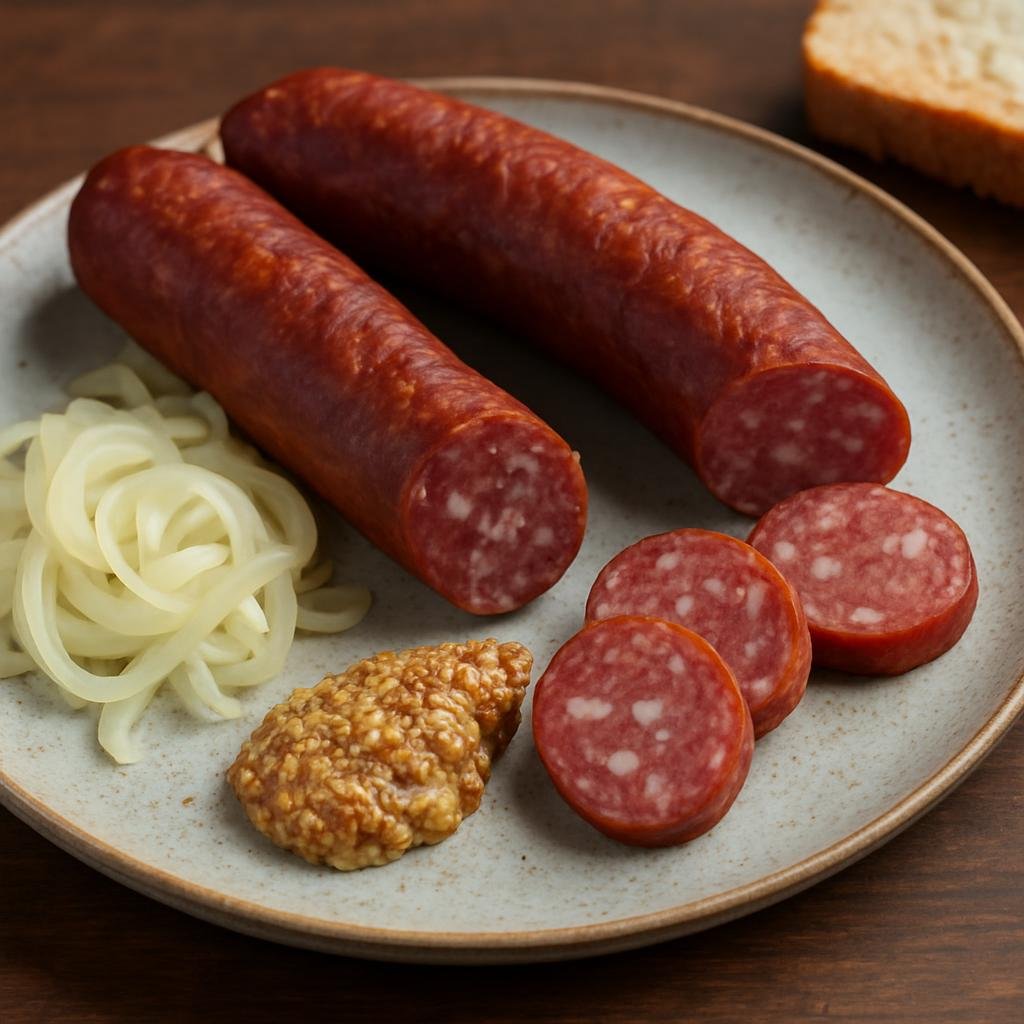
Entree: Netherlands – Friesland – Friese Droge Worst (Dry-cured smoked pork sausage traditional to Friesland)
Food safety reminder: Follow safe food-handling practices and use a food thermometer to verify safe internal cooking temperatures.
Serving Size: 8
Approximate Time
Prep
45 min
Cook
12 min
Additional
200 hrs 48 min
Total
201 hrs 36 min
Ingredients
- 4 lb (1.8 kg) boneless pork shoulder, trimmed and cut into chunks
- 1 lb (454 g) pork back fat, chilled and cut into chunks
- 2 tbsp (30 g) kosher salt
- 1 tsp (5 g) Prague Powder #1 (curing salt)
- 2 tsp (4 g) freshly ground black pepper
- 1 tsp (2 g) ground nutmeg
- 1/2 tsp (1 g) ground cloves
- 1 tsp (3 g) crushed juniper berries, lightly crushed
- 2 tsp (8 g) dextrose or granulated sugar
- 2 cloves garlic, minced
- 10–12 ft (3–3.7 m) hog casings, soaked and rinsed
- 2 cups (approx. 480 ml) wood chips for smoking (beech, oak, or fruitwood)
- Cheesecloth or curing netting for hanging (if air-drying)
Instructions
U.S. measurements first, metric equivalents in parentheses. Conversions are approximate.
1. Chill meat and fat until very firm, then grind through a coarse plate (about 0.236 to 0.315 in (6–8 mm)). Keep mixture cold at all times.
2. In a large bowl, combine ground pork and fat with kosher salt, Prague Powder #1, black pepper, nutmeg, cloves, crushed juniper, dextrose, and minced garlic. Mix thoroughly until sticky and spices are evenly distributed.
3. Fill a sausage stuffer and stuff mixture into prepared hog casings, making 8 large links (about 6–8 oz (170–225 g) each). Twist and tie into links, pricking any air pockets with a sterile needle.
4. Optional short fermentation: hang sausages in a cool (60–65°F / 15–18°C), humid (80–85% RH) spot for 12–24 hours to develop mild tang. This step is traditional but optional for home kitchens.
5. Cold-smoke sausages at low temperature, around 100–140°F (38–60°C), for 6–12 hours until a good smoky color is achieved and internal temperature reaches 150°F (66°C). Use mild wood (beech, oak, apple) for a traditional flavor.
6. After smoking, hang sausages in a cool (50–60°F / 10–15°C), well-ventilated place with 70–75% relative humidity to dry for 7–14 days until firm but not rock hard. Alternatively, dry in a regulated curing chamber or refrigerator adapter set for drying.
7. When firm and dry to your preference, store in the refrigerator or cellar wrapped in paper. Slice thinly to serve with rye bread, mustard, or Dutch cheese.
Show original instructions
1. Chill meat and fat until very firm, then grind through a coarse plate (about 6–8 mm). Keep mixture cold at all times.
2. In a large bowl, combine ground pork and fat with kosher salt, Prague Powder #1, black pepper, nutmeg, cloves, crushed juniper, dextrose, and minced garlic. Mix thoroughly until sticky and spices are evenly distributed.
3. Fill a sausage stuffer and stuff mixture into prepared hog casings, making 8 large links (about 6–8 oz / 170–225 g each). Twist and tie into links, pricking any air pockets with a sterile needle.
4. Optional short fermentation: hang sausages in a cool (60–65°F / 15–18°C), humid (80–85% RH) spot for 12–24 hours to develop mild tang. This step is traditional but optional for home kitchens.
5. Cold-smoke sausages at low temperature, around 100–140°F (38–60°C), for 6–12 hours until a good smoky color is achieved and internal temperature reaches 150°F (66°C). Use mild wood (beech, oak, apple) for a traditional flavor.
6. After smoking, hang sausages in a cool (50–60°F / 10–15°C), well-ventilated place with 70–75% relative humidity to dry for 7–14 days until firm but not rock hard. Alternatively, dry in a regulated curing chamber or refrigerator adapter set for drying.
7. When firm and dry to your preference, store in the refrigerator or cellar wrapped in paper. Slice thinly to serve with rye bread, mustard, or Dutch cheese.
Estimated Nutritional Information*
Per serving | Servings: 8
Calories: 1001 kcal
Carbohydrates: 2 g
Protein: 40.5 g
Fat: 91 g
Saturated fat: 32.4 g
Cholesterol: 192 mg
Fiber: 0.3 g
Sodium: 1607 mg
Potassium: 732 mg
Calcium: 43 mg
Iron: 2.59 mg
Vitamin A: 8 µg RAE
Vitamin C: 2 mg
Vitamin D: 5.6 µg
Nutrition estimated: November 5, 2026
*Values are estimates based on USDA data and mathematical calculations. Actual values may vary. Where data are unavailable, those contributions are excluded. Calories, Carbohydrates, Protein, Fat, Saturated fat, Cholesterol, Fiber, Sodium, Potassium, Calcium, Iron, Vitamin A, Vitamin C and Vitamin D are known subtotals. Missing contributions are unknown, not zero.