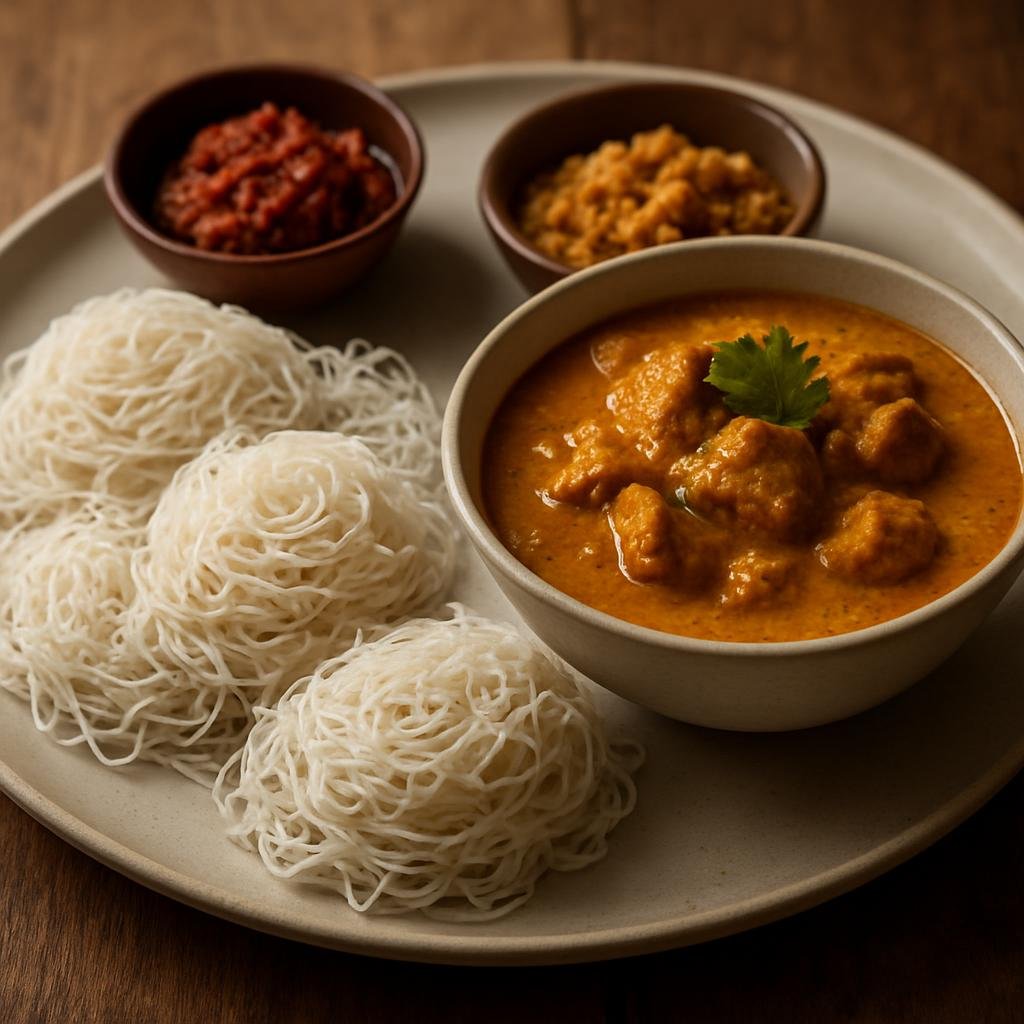
Entree: Sri Lanka – Colombo & Western Sri Lanka – String Hoppers with Curry (steamed rice noodle nests served with a fragrant coconut-based curry and traditional condiments)
Food safety reminder: Follow safe food-handling practices and use a food thermometer to verify safe internal cooking temperatures.
Serving Size: 4
Approximate Time
Prep
40 min
Cook
45 min
Additional
10 min
Total
1 hr 30 min
Ingredients
U.S. measurements first, metric equivalents in parentheses. Conversions are approximate; oz means weight ounces, not fluid ounces.
- For the string hoppers (idiyappam):
  - 2 cups (250 g) roasted rice flour or fine rice flour
  - 1 1/4 cups (300 ml) boiling water
  - 1/2 tsp (3 g) salt
  - 1 tbsp (15 ml) coconut oil or vegetable oil
- For the coconut chicken curry:
  - 1 lb (454 g) chicken pieces, bone-in preferred
  - 2 tbsp (30 ml) coconut oil or vegetable oil
  - 1 medium onion, thinly sliced
  - 3 cloves garlic, minced
  - 1 inch (2.5 cm) piece ginger, minced
  - 2 tbsp (30 ml) Sri Lankan roasted curry powder
  - 1 tsp (5 g) turmeric powder
  - 2 green chilies, slit
  - 10–12 curry leaves
  - 1 cinnamon stick
  - 1 cup (240 ml) thin coconut milk or water
  - 1 1/2 cups (360 ml) coconut milk, divided (use about 1 cup (240 ml) during cooking, 1/2 cup (120 ml) to finish)
  - Salt to taste
  - 1 tbsp (15 ml) lime juice
- For pol sambol (coconut condiment):
  - 1 cup (80 g) freshly grated coconut
  - 1 small red onion, finely chopped
  - 1–2 tsp (5–10 g) Maldive fish flakes or 1 tsp (5 ml) fish sauce (optional)
  - 1 tsp (5 g) chili powder or to taste
  - 1/2 tsp (2.5 g) salt
  - 1 tbsp (15 ml) lime juice
Show original ingredient measurements
- For the string hoppers (idiyappam):
  - 2 cups (250 g) roasted rice flour or fine rice flour
  - 1 1/4 cups (300 ml) boiling water
  - 1/2 tsp (3 g) salt
  - 1 tbsp (15 ml) coconut oil or vegetable oil
- For the coconut chicken curry:
  - 1 lb (454 g) chicken pieces, bone-in preferred
  - 2 tbsp (30 ml) coconut oil or vegetable oil
  - 1 medium onion, thinly sliced
  - 3 cloves garlic, minced
  - 1 inch (2.5 cm) piece ginger, minced
  - 2 tbsp (30 ml) Sri Lankan roasted curry powder
  - 1 tsp (5 g) turmeric powder
  - 2 green chilies, slit
  - 10–12 curry leaves
  - 1 cinnamon stick
  - 1 cup (240 ml) thin coconut milk or water
  - 1 1/2 cups (360 ml) coconut milk, divided (use about 1 cup during cooking, 1/2 cup to finish)
  - Salt to taste
  - 1 tbsp (15 ml) lime juice
- For pol sambol (coconut condiment):
  - 1 cup (80 g) freshly grated coconut
  - 1 small red onion, finely chopped
  - 1–2 tsp (5–10 g) Maldive fish flakes or 1 tsp (5 ml) fish sauce (optional)
  - 1 tsp (5 g) chili powder or to taste
  - 1/2 tsp (2.5 g) salt
  - 1 tbsp (15 ml) lime juice
Instructions
U.S. measurements first, metric equivalents in parentheses. Conversions are approximate.
1. Make the string hopper dough: place rice flour and salt in a bowl. Pour boiling water in gradually, stirring with a spoon until a soft, cohesive dough forms. Stir in 1 tbsp (15 ml) coconut oil and knead briefly until smooth and pliable; cover to keep warm.
2. Prepare steaming plates or idiyappam trays by lightly oiling. Fill an idiyappam press or a noodle press with the dough and press into 3–4 inch (7–10 cm) round nests onto the prepared plates. If no press, pipe through a clean cloth with small holes.
3. Steam the nests over high heat for 8–10 minutes until set and opaque. Remove and keep covered to retain moisture.
4. For the curry: heat 2 tbsp (30 ml) coconut oil in a pot over medium heat. Fry sliced onions until soft and golden. Add garlic and ginger and sauté 1 minute.
5. Add curry powder, turmeric, cinnamon stick, and curry leaves; fry briefly until aromatic. Add chicken pieces and toss to coat with the spice mixture, browning lightly for 2–3 minutes.
6. Pour in 1 cup (240 ml) thin coconut milk or water, bring to a simmer, cover and cook 15–20 minutes until chicken is nearly tender. Stir in 1 cup (240 ml) coconut milk and simmer uncovered until sauce thickens and chicken is cooked through, about 8–10 minutes. Finish with remaining 1/2 cup (120 ml) coconut milk, lime juice, and salt to taste.
7. Make pol sambol: combine grated coconut, chopped red onion, fish flakes or fish sauce if using, chili powder, salt, and lime juice; mix until evenly distributed.
8. To serve: arrange warm string hoppers with a generous ladle of coconut chicken curry and a spoonful of pol sambol on the side.
Show original instructions
1. Make the string hopper dough: place rice flour and salt in a bowl. Pour boiling water in gradually, stirring with a spoon until a soft, cohesive dough forms. Stir in 1 tbsp coconut oil and knead briefly until smooth and pliable; cover to keep warm.
2. Prepare steaming plates or idiyappam trays by lightly oiling. Fill an idiyappam press or a noodle press with the dough and press into 3–4 inch (7–10 cm) round nests onto the prepared plates. If no press, pipe through a clean cloth with small holes.
3. Steam the nests over high heat for 8–10 minutes until set and opaque. Remove and keep covered to retain moisture.
4. For the curry: heat 2 tbsp coconut oil in a pot over medium heat. Fry sliced onions until soft and golden. Add garlic and ginger and sauté 1 minute.
5. Add curry powder, turmeric, cinnamon stick, and curry leaves; fry briefly until aromatic. Add chicken pieces and toss to coat with the spice mixture, browning lightly for 2–3 minutes.
6. Pour in 1 cup (240 ml) thin coconut milk or water, bring to a simmer, cover and cook 15–20 minutes until chicken is nearly tender. Stir in 1 cup (240 ml) coconut milk and simmer uncovered until sauce thickens and chicken is cooked through, about 8–10 minutes. Finish with remaining 1/2 cup (120 ml) coconut milk, lime juice, and salt to taste.
7. Make pol sambol: combine grated coconut, chopped red onion, fish flakes or fish sauce if using, chili powder, salt, and lime juice; mix until evenly distributed.
8. To serve: arrange warm string hoppers with a generous ladle of coconut chicken curry and a spoonful of pol sambol on the side.
Estimated Nutritional Information*
Per serving | Servings: 4
Calories: 783 kcal
Carbohydrates: 71.9 g
Protein: 9.4 g
Fat: 54.2 g
Fiber: 10.5 g
Calcium: 85 mg
Iron: 4.93 mg
Vitamin C: 19.7 mg
Generated: 2026-11-05T19:41:07+00:00
*Values are estimates based on USDA data and mathematical calculations. Actual values may vary. Where data are unavailable, those contributions are excluded. Calories, Carbohydrates, Protein, Fat, Fiber, Calcium, Iron and Vitamin C are known subtotals. Missing contributions are unknown, not zero.