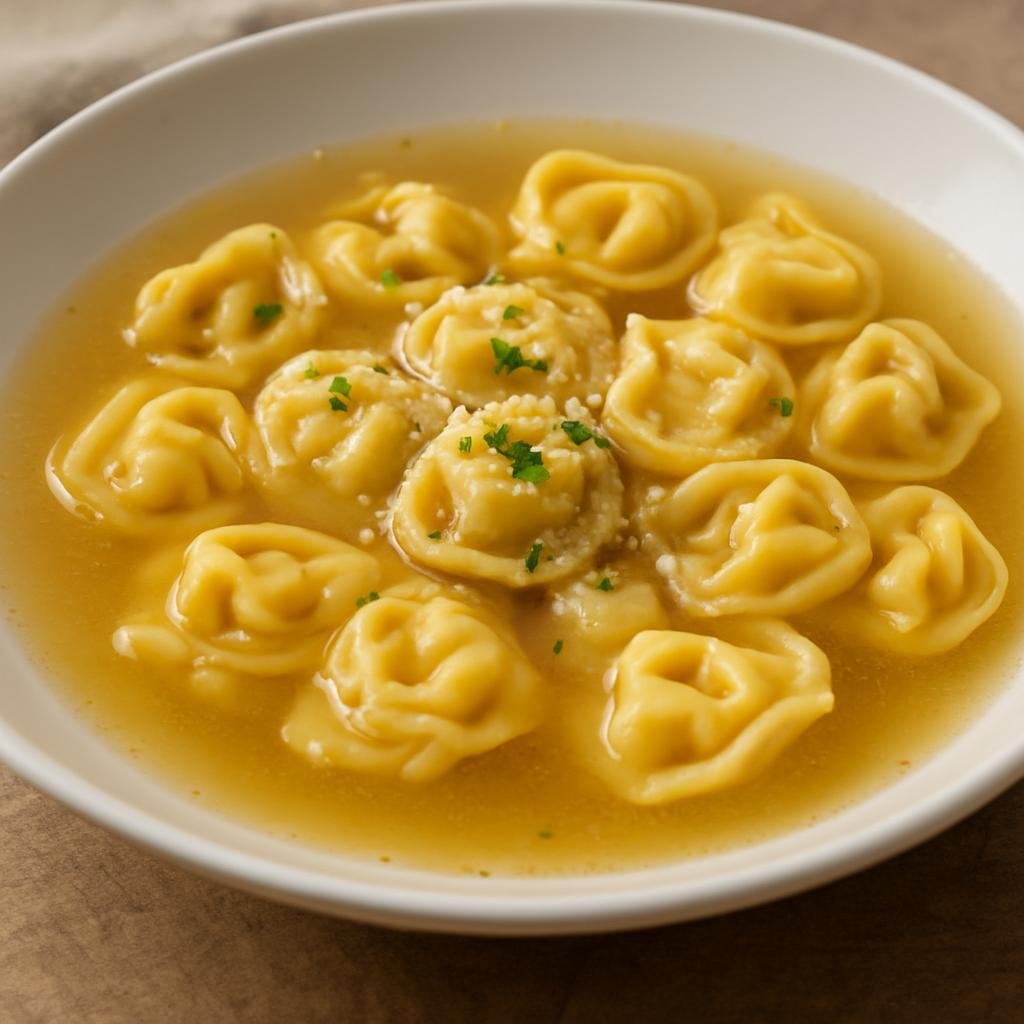
Entree: San Marino – Cappelletti in Brodo (Stuffed pasta in clear meat broth)
Food safety reminder: Follow safe food-handling practices and use a food thermometer to verify safe internal cooking temperatures.
Ingredients
U.S. measurements first, metric equivalents in parentheses. Conversions are approximate; oz means weight ounces, not fluid ounces.
- 2 cups (250 g) all-purpose flour
- 3 large eggs (approx. 5 1/4 oz (150 g))
- 1/2 tsp (3 g) fine salt, plus more for brodo
- 1 tbsp (15 ml) extra-virgin olive oil
- 8 oz (225 g) ground pork
- 2 oz (60 g) prosciutto, finely chopped
- 2 oz (60 g) mortadella, finely chopped
- 1/2 cup (50 g) grated Parmigiano-Reggiano, plus extra for serving
- 1/4 tsp (0.5 g) ground nutmeg
- Freshly ground black pepper, to taste
- 1 whole chicken, approx. 3 lb (1.4 kg), halved or cut into pieces (for broth)
- 1 lb (450 g) beef marrow bones or soup bones (for broth) (such as beef marrow bones)
- 1 medium onion, halved (approx. 5 1/4 oz (150 g))
- 2 carrots, roughly chopped (approx. 5 1/4 oz (150 g))
- 2 stalks celery, roughly chopped (approx. 3 1/2 oz (100 g))
- 10 cups (2.5 L) cold water
- 2 bay leaves
- 1 small bunch fresh parsley (tied) (approx. 1 1/16 oz (30 g))
- Black peppercorns, 8–10 whole
Show original ingredient measurements
- 2 cups (250 g) all-purpose flour
- 3 large eggs (approx. 150 g)
- 1/2 tsp (3 g) fine salt, plus more for brodo
- 1 tbsp (15 ml) extra-virgin olive oil
- 8 oz (225 g) ground pork
- 2 oz (60 g) prosciutto, finely chopped
- 2 oz (60 g) mortadella, finely chopped
- 1/2 cup (50 g) grated Parmigiano-Reggiano, plus extra for serving
- 1/4 tsp (0.5 g) ground nutmeg
- Freshly ground black pepper, to taste
- 1 whole chicken, approx. 3 lb (1.4 kg), halved or cut into pieces (for broth)
- 1 lb (450 g) beef marrow bones or soup bones (for broth) (such as beef marrow bones)
- 1 medium onion, halved (approx. 150 g)
- 2 carrots, roughly chopped (approx. 150 g)
- 2 stalks celery, roughly chopped (approx. 100 g)
- 10 cups (2.5 L) cold water
- 2 bay leaves
- 1 small bunch fresh parsley (tied) (approx. 30 g)
- Black peppercorns, 8–10 whole
Instructions
U.S. measurements first, metric equivalents in parentheses. Conversions are approximate.
1. Make the broth: place the chicken pieces and beef bones in a large stockpot with the halved onion, carrots, celery, bay leaves, parsley bundle, peppercorns and 10 cups (2.5 L) cold water. Bring to a gentle simmer over medium-low heat, skimming any foam for the first 20 minutes. Reduce heat and simmer very gently, partially covered, for 2 1/2–3 hours. Strain the broth through a fine-mesh sieve, discard solids, season to taste with salt, and keep hot.
2. Prepare the pasta dough: mound the flour on a work surface, make a well and crack the eggs into it with 1/2 tsp (3 g) salt. Gradually incorporate flour into eggs, kneading until a smooth, elastic dough forms, 8–10 minutes. Wrap in plastic and rest 30 minutes at room temperature.
3. Make the filling: heat 1 tbsp (15 ml) olive oil in a skillet over medium heat. Add the ground pork and cook until no longer pink, breaking up with a spoon, 5–7 minutes. Remove from heat, stir in chopped prosciutto, chopped mortadella, 1/2 cup (50 g) grated Parmigiano-Reggiano, 1/4 tsp (0.5 g) nutmeg and freshly ground black pepper to taste. Cool the mixture, then taste and adjust salt/pepper.
4. Roll and cut the pasta: roll the dough thin (to about 0.0394 in (1 mm)) using a pasta machine or rolling pin. Cut into squares about 2 in (5 cm) on a side. Place a small pea-sized amount (about 1/2 tsp (2–3 g)) of filling in the center of each square. Moisten edges with water, fold into a triangle, press edges to seal, then bring the two corners of the long side together and press to form the classic cappelletti hat shape.
5. Cook the cappelletti in brodo: bring the strained hot broth to a gentle simmer. Add cappelletti in batches so they have room and cook until they float and the pasta is tender, 3–4 minutes per batch. Use a slotted spoon to transfer to warmed bowls and ladle hot broth over them.
6. Finish and serve: top each serving with a little extra grated Parmigiano-Reggiano and a grind of black pepper. Serve immediately while the brodo is steaming.
Show original instructions
1. Make the broth: place the chicken pieces and beef bones in a large stockpot with the halved onion, carrots, celery, bay leaves, parsley bundle, peppercorns and 10 cups (2.5 L) cold water. Bring to a gentle simmer over medium-low heat, skimming any foam for the first 20 minutes. Reduce heat and simmer very gently, partially covered, for 2 1/2–3 hours. Strain the broth through a fine-mesh sieve, discard solids, season to taste with salt, and keep hot.
2. Prepare the pasta dough: mound the flour on a work surface, make a well and crack the eggs into it with 1/2 tsp (3 g) salt. Gradually incorporate flour into eggs, kneading until a smooth, elastic dough forms, 8–10 minutes. Wrap in plastic and rest 30 minutes at room temperature.
3. Make the filling: heat 1 tbsp (15 ml) olive oil in a skillet over medium heat. Add the ground pork and cook until no longer pink, breaking up with a spoon, 5–7 minutes. Remove from heat, stir in chopped prosciutto, chopped mortadella, 1/2 cup (50 g) grated Parmigiano-Reggiano, 1/4 tsp (0.5 g) nutmeg and freshly ground black pepper to taste. Cool the mixture, then taste and adjust salt/pepper.
4. Roll and cut the pasta: roll the dough thin (to about 1 mm) using a pasta machine or rolling pin. Cut into squares about 2 in (5 cm) on a side. Place a small pea-sized amount (about 1/2 tsp / 2–3 g) of filling in the center of each square. Moisten edges with water, fold into a triangle, press edges to seal, then bring the two corners of the long side together and press to form the classic cappelletti hat shape.
5. Cook the cappelletti in brodo: bring the strained hot broth to a gentle simmer. Add cappelletti in batches so they have room and cook until they float and the pasta is tender, 3–4 minutes per batch. Use a slotted spoon to transfer to warmed bowls and ladle hot broth over them.
6. Finish and serve: top each serving with a little extra grated Parmigiano-Reggiano and a grind of black pepper. Serve immediately while the brodo is steaming.
Per serving | Servings: 4
Nutrition estimated: November 6, 2026
*Values are estimates based on USDA data and mathematical calculations. Actual values may vary. Where data are unavailable, those contributions are excluded. Calories, Carbohydrates, Protein, Fat, Saturated fat, Cholesterol, Fiber, Sodium, Potassium, Calcium, Iron, Vitamin A and Vitamin C are known subtotals. Missing contributions are unknown, not zero.