Entree: Estonia – Central Culinary Region – Verivorst (Blood sausage)
Food safety reminder: Follow safe food-handling practices and use a food thermometer to verify safe internal cooking temperatures.
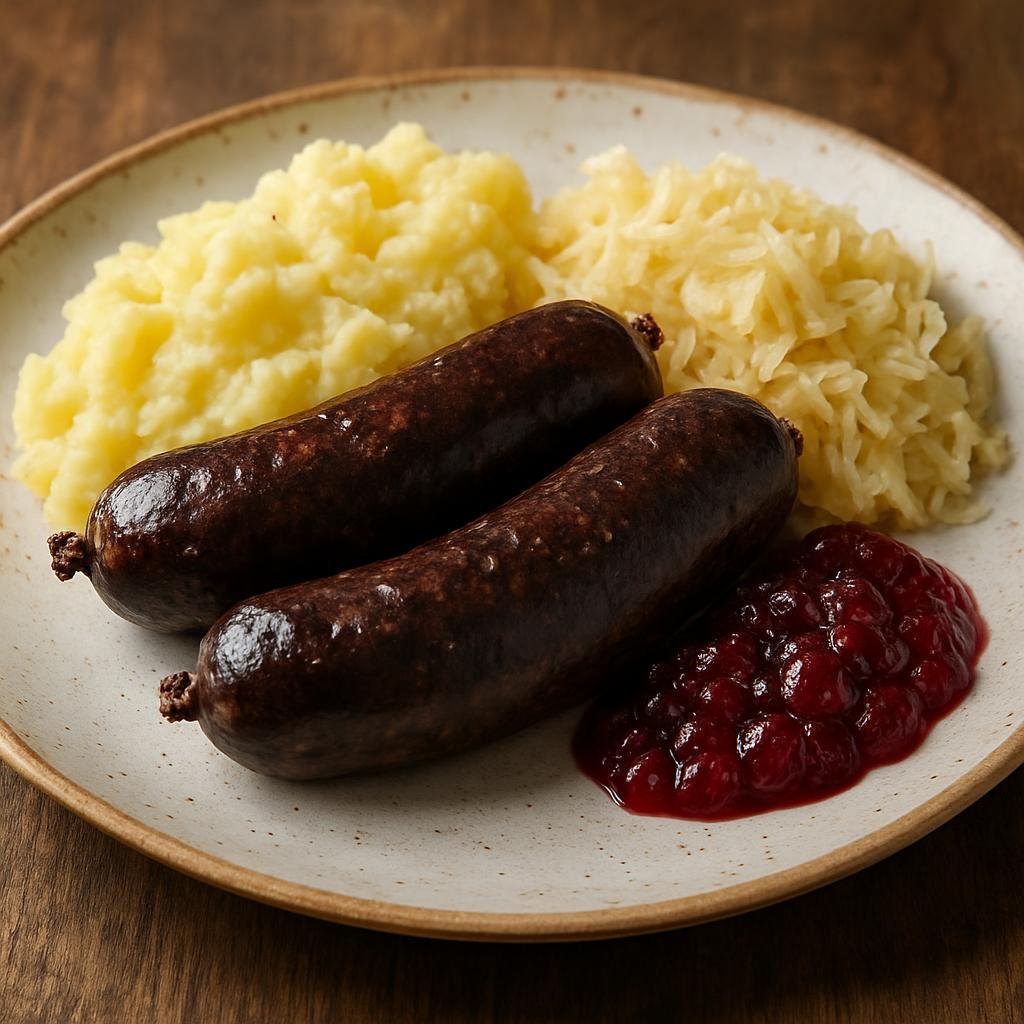
Serving Size: 6
Approximate Time
Prep
30 min
Cook
50 min
Total
1 hr 20 min
Ingredients
U.S. measurements first, metric equivalents in parentheses. Conversions are approximate; oz means weight ounces, not fluid ounces.
- 2 lb (900 g) pork shoulder, finely diced
- 8 oz (225 g) pork fatback, finely diced
- 2 cups (480 ml) fresh pig's blood
- 1 cup (200 g) pearl barley (dry)
- 2 cups (480 ml) whole milk (for cooking barley)
- 2 medium onions, approx. 10 oz (280 g), finely chopped
- 1 tbsp (15 ml) lard or butter
- 1/2 cup (60 g) rye flour (or coarse rye breadcrumbs)
- 1 1/2 tsp (8 g) salt
- 1 tsp (2 g) ground black pepper
- 1 tsp (2 g) ground allspice
- 1 tsp (1 g) dried marjoram (or 1 tbsp (15 ml) fresh, chopped)
- 6–8 ft (70 7/8 to 94 1/2 in (180–240 cm)) natural hog casings, soaked and rinsed
- 2 tbsp (30 ml) butter (for frying)
- Lingonberry jam, for serving (optional)
Show original ingredient measurements
- 2 lb (900 g) pork shoulder, finely diced
- 8 oz (225 g) pork fatback, finely diced
- 2 cups (480 ml) fresh pig's blood
- 1 cup (200 g) pearl barley (dry)
- 2 cups (480 ml) whole milk (for cooking barley)
- 2 medium onions, approx. 10 oz (280 g), finely chopped
- 1 tbsp (15 ml) lard or butter
- 1/2 cup (60 g) rye flour (or coarse rye breadcrumbs)
- 1 1/2 tsp (8 g) salt
- 1 tsp (2 g) ground black pepper
- 1 tsp (2 g) ground allspice
- 1 tsp (1 g) dried marjoram (or 1 tbsp fresh, chopped)
- 6–8 ft (180–240 cm) natural hog casings, soaked and rinsed
- 2 tbsp (30 ml) butter (for frying)
- Lingonberry jam, for serving (optional)
Instructions
1. Soak the pearl barley in 1 cup (240 ml) cold water for 30 minutes, then drain. Combine the barley with 2 cups (480 ml) whole milk in a pot, bring to a simmer and cook gently until the barley is tender and most liquid is absorbed, about 25–30 minutes; cool slightly.
2. In a large skillet, heat 1 tbsp (15 ml) lard or butter over medium heat. Add the finely chopped onions and sauté until translucent and soft, about 8–10 minutes; set aside to cool.
3. In a large bowl combine the diced pork shoulder and pork fatback with the cooked barley, sautéed onions, rye flour, salt, black pepper, allspice and marjoram. Mix thoroughly to distribute the fat and seasonings.
4. Slowly stir the fresh pig's blood into the meat-and-barley mixture until evenly combined; the mixture should be moist but not runny. Adjust seasoning to taste.
5. Fit a sausage stuffer or piping bag with the prepared hog casings and fill gently, avoiding large air pockets. Tie off sausages into 6–8 links, about 4–6 inches (10–15 cm) long. Prick any large air bubbles with a needle.
6. Bring a large pot of water to a bare simmer (not boiling) and poach the sausages gently for 20–30 minutes until firm to the touch; maintain water temperature around 170–180°F (75–82°C). Remove and cool briefly.
7. To serve, heat 2 tbsp (30 ml) butter in a skillet over medium-high heat and pan-fry the verivorst until the casings are crisp and browned, 3–4 minutes per side. Serve hot with lingonberry jam or traditional accompaniments such as sauerkraut and boiled potatoes.
8. Leftover verivorst can be cooled, refrigerated and lightly fried or grilled the next day; the texture improves after resting.
Estimated Nutritional Information*
Per serving | Servings: 6
Calories: 936 kcal
Carbohydrates: 42.4 g
Protein: 34.4 g
Fat: 69.4 g
Saturated fat: 26.4 g
Cholesterol: 148 mg
Fiber: 6.5 g
Sodium: 689 mg
Potassium: 769 mg
Calcium: 146 mg
Iron: 3.26 mg
Vitamin A: 76 µg RAE
Vitamin C: 4.8 mg
Vitamin D: 4.8 µg
Nutrition estimated: November 5, 2026
*Values are estimates based on USDA data and mathematical calculations. Actual values may vary. Where data are unavailable, those contributions are excluded. Calories, Carbohydrates, Protein, Fat, Saturated fat, Cholesterol, Fiber, Sodium, Potassium, Calcium, Iron, Vitamin A, Vitamin C and Vitamin D are known subtotals. Missing contributions are unknown, not zero.